Friday, December 23, 2011
First Winter Solstice Reflection
Some of my reflections on this world are geometric. This planet Earth we live and travel on is pretty close to being a sphere, slightly squeezed at the poles, so it's actually a little bit of an ellipsoid. This planet travels around the Sun in a slightly elliptical pattern, at a distance varying between 91 million and 93 million miles. One journey around the Sun we call a year. This planet rotates around on an axis in a period we call a day. The axis is tilted 23 degrees in such a way that the equator is not parallel to the plane containing the Earth's path around the Sun. This produces an annual sine-wave pattern in which we have long days around Summer solstice, shortening days in Fall, long nights at Winter solstice, with Spring's daylight again lengthening to complete the cycle.
As sure as the rhythm of our hearts and our breathing, the Earth's rhythmic patterns sustain life. This life we live within provides so much for us, it's difficult not to be reverent unless we forget this providence. It is a mysterious source of love and an ongoing succession of further life. When we are mindful to appreciate and adore this astonishing gift, we can be found doing the strangest things.
Labels: 7th UU principle, astrophysics, reverence, sermons, theological sources


Friday, February 25, 2011
our treatment of the poor continues to put the whip to christ's back
Labels: astrophysics, Christianity, christology, classism, homelessness, politics
Thursday, November 19, 2009
A new look at the Solar System
Including this link as a personal bookmark because, "Wow, come to think of it, I haven't really gotten to look closely at the solar system planets since junior high. Not really..."
lyrics: "Power of the Holy Ghost. Woof, woof, woof!"
From Burning Beard, by Clutch.
pax hominibus,
agape to all,
joel
Labels: astrophysics, personal bookmarks, technology
Sunday, September 27, 2009
G-20, and Carl Sagan Video
First, I've been a little heads-down getting my sermon ready for today. And now I'm seeing the news that a "non-lethal sonic cannon" was used against protesters/rioters in Pittsburgh at the G-20 meeting. This is the first time such a device was used by government forces against people within our own boundaries. It was used not against peaceful protesters, but against rioters. As a device used within these parameters, its non-lethality may have saved lives, but a device like this SHOULD NOT BE NECESSARY.
The problem, as noted in the commentary on this article, is that the attendees at the G20 are not representative of the people. This is most definitely NOT common ground. It is the upper-most echelon of wealth determining where and how to deploy resources, with little attention to local movements, or to the states of poverty in the world. The problem is that there are people who WANT to riot. To suppress the riots is only a solution if you already have your main goal mapped out, and that goal does not include the will of the people. In the end, the effective solution will be to make sure that everyone (regardless of race, class, or nationality) has real voice/representation and truly get an adequate piece of the economic pie.
As the world population continues to grow, while our resources (especially the ability to feed ourselves and provide clean water) diminish, the riots will continue and escalate, unless the leaders exhibit real leadership embodying the will of the people and serving their needs, not the needs of those who seek to amass wealth.
There is no shortage of money. There are still enough resources to go around, and certainly MORE THAN ENOUGH LABOR to go around. The important thing is that those who make decisions that affect massive numbers of people (CEO's, business leaders, G20 participants) use the resources justly and effectively. None of my senses tell me that is happening on their part. Until the leaders do that, or the unwilling followers can successfully break from them, the world will be frustrated, and we'll have no glory, no justice, no liberation, and no peace.
Here's the awesome Carl Sagan video, and this great quote:
"If you wish to make an apple pie from scratch, you must first invent the universe."

lyrics: "The simplest thought, like the concept of the number 1, has an elaborate logical underpinning. The brain has its own language for testing the structure and consistency of the world." - Carl Sagan
pax hominibus,
agape to all,
joel
Labels: astrophysics, Book of Romans, Capitalism, economics, globalism, oppression
Text from Sermon #1: Regarding Candlepower
.
Regarding Candlepower
Delivered 9.27.2009 at First Unitarian Universalist Society of San Francisco
Light does not sit still. It wants to spread in every direction until it hits something to reflect off of, or to be absorbed.
But doesn’t the word “light” describe more than just matter or energy? From a spiritual perspective, light is knowledge, information, and reason—and even emotion. Light shows the paths available to us, and the light of understanding can help to dispel fear and confusion.
Candlepower is another term for luminous intensity, or how bright a light appears to be shining.
The title of this sermon is also a reference to actual candles. Now, I want to start with a brief story about a candle we have at home. He’s sitting right back there with his mom and grandma, and his name is Henry. Sometimes our infant wakes up alone in the bedroom with the lights out, and starts to wailing. I’ll go in and scoop him up to my chest, get the drool towel on my shoulder, and rock him back to sleep while singing in the darkened room. His favorite lullaby is actually a variant of “This Little Light of Mine” from our hymnal. He likes it best when I sing it under water. The underwater version goes something like this: “Thbibs lbibttble lbibliblbght obf mbibne, iblbl’m gmloblbing tblblo let it shine.” As soon as he gets close to nodding off, I switch over to a steady rhythmic version that I call the “Seraphim’s Lullaby.” In Judeo-Christian lore, the seraphim are the inner ring of angels singing songs of praise night and day to God.
This lullaby echoes the last word from “this little light of mine” in a rhythm as he starts to nod off. “Shine, shine,… shine, shine, shine,… shine, shine, shine,… shine, shine, shine ,… shine, shine, shine ,… shine, shine, shine ,… shine, shine, shine , shine-shine,” which then repeats. Then as Henry’s totally conking out from the monotony, I work my way down to singing “Shine…” every eight beats, until I can finally lay him down slowly in the crib.
That to me is one example of a candle, it’s some personal information, a message that I sing to my baby, a prayer whose seeds will hopefully be planted deep within, for him to shine his light steady and strong, whatever that may turn out to be. And each of us has different messages, and different light to shed onto the world. Our light is composed of our experiences, perspectives, passions and hopes. Getting in touch with the uniqueness of our own light is a process of constant unfolding. Then when we shine out, it’s through our words and our deeds—through our life itself.
When our candles of life come together, they inform each other. By listening intently to the experiences, perspectives, passions and hopes of another, the light in ourselves grows in intensity, or changes hue. We can feel more strongly about our truths, or develop a more nuanced understanding. And when our own light is flickering, one candle can always light another, and that’s one empowering blessing of being among a community of broad-minded thinkers and compassionate feelers.
When enough people share in community, we have a rich discourse that becomes a bonfire, where we can not only have light, but also warmth, and sometimes “heat” when we come to disagreements. I’ve already witnessed that this congregation’s conversations are often energized enough to grow from words into action. And the fire turns into steady-burning coals….19th-century Universalist Mary Livermore tells a story how before there were matches, if your kitchen’s fire went out in the night, you either needed to work flint and steel together until a spark caught so you could light your tinder and rebuild your own fire from scratch (a painful proposition), or you would beg a shovelful of coals from a neighbor. A vibrant and thriving religious community like this one has coals it can offer, not just to the Sunday afternoon fellowship, the Lutherans, the Buddhists, and the other groups that meet here, but to the wider community. And they have coals that would enrich us as well.
A campfire like ours at First Unitarian Universalist is highly visible, and draws people in from further away. That’s our goal—to grow spiritually as a community, and draw people in, so that new visitors and old members alike can come here to fan the flames of their passions for justice, and become more active in the world. Here’s a question to ponder, what things have you found here that make you come to life, and make it natural to devote your time and energy here?
[pause for water, smack water glass against pulpit by accident]
Yet while a roaring fire is more robust than an individual candle, even our campfires are in danger of being blown out or diminished by the rain and the wind of an environment that doesn’t know to value what we have here. It’s all the more frightful when we find our voices shut out of the mass media, and there are other voices amplifying values that run counter to ours. Our good news that God loves everyone, and that everyone is saved isn’t likely to be well-received if it can’t be heard, or runs contrary to nihilistic and damaging messages blaring through the airwaves.
Our message presents danger to some people. For some, our news means questioning their whole worldview based on a personal and everlasting life, and accepting a savior to overcome sins. For others, it means weighing their relationship to the Earth and the welfare of its inhabitants against their own self-interests. Questioning fundamental assumptions and habits like these is difficult, and when people first hear our good news—and I realize there may be some sitting right out here today, or perhaps listening online—when people first hear our good news, we are a new candle joining an existing candle, which burns differently.
So our light can attract hostilities as well as friends. Our message brings cognitive dissonance and fear to some. Our goals may run counter to their goals of maintaining their livelihood, their lifestyle, or their retirement plans, or their hopes and fears for an afterlife, so they will fight our message. From Jesus decrying the Pharisees killing of prophets in Matthew 23, to Hypatia of Alexandria, to MLK, all the way to Van Jones, the brightest luminaries have been under attack by powers with vested interests, with their light diminished, sullied, or even snuffed-out. Humanist philosopher Erich Fromm says, “Those whose hope is weak settle down for comfort or violence; those whose hope is strong see and cherish all signs of new life, and are ready at every moment to help give birth to that which is ready to be born.” What light exists that can finally burn brightly enough that it cannot be snuffed out?
The Sun is one such source of light that will be constant and shining for ages to come. What would it take to get our message THAT bright? How about a compelling enough message to help draw in a critical mass of people sharing their lights on a global scale? Our message is right on: everyone’s together in this spherical blue and green boat, everyone’s included, and nobody should be left behind. Our message is one of communities rooted where they are, and extending out to any other communities who would join in common cause. The sixth Unitarian Universalist principle, states “[We...covenant to affirm and promote] the goal of world community with peace, liberty and justice for all.” The thought that the sixth principle might come into reality is awe-inspiring, isn’t it? That’d be a huge change! One I hope we all learn to truly welcome.
The principle says “the goal of world community.” A goal is a dream with a deadline. We’re not about affirming the dream of a world community with peace, liberty, and justice for all. It’s a goal. There’s got to be a deadline, or the light is blurry. If we leave the deadline unset, then that’s just a dream deferred. That’s justice deferred, peace deferred, and liberty deferred.
So, what do we envision—how will we know when the goal of “world community” is successfully realized? It requires that we establish common ground on which to speak and listen freely. We can start by all acknowledging our common humanity, and the worth and dignity to be found in everyone. Until we do that, we’re standing on different ground, not common ground. From common ground, we can freely share the lights of our myriad communities of identity. And with that common ground conversation, we can equitably negotiate shared definitions for peace, liberty and justice.
We’ll need to do a lot of work to get to that common ground. From physics, power is defined asthe ability to do work in a given amount of time. A more powerful movement can get more work done more quickly. A more powerful movement is composed of more people participating more fully.
Today’s second lesson is the story of Aten, the god responsible for the Sun. This god was represented by a bright disk in the sky, with arms reaching out of it, each with a hand bearing gifts. More hands, more voices, more lives working for common ground means more power and faster work toward our goal. Not everybody’s going to join our churches. Perhaps they disagree with organized religion entirely, or perhaps they’re happy with the worship and the people of their own faith communities. But surely they will lend their hands and co-create with us once they see the light of our message, and our goal. And our fourth principle—the one about our “free and responsible search for truth and meaning” compels us to share this light with them, pronto. For when we truly embody truth and meaning, we find we’re responsible to act on it, and share it.
Until we create a deadline that we mean to be accountable to, there’s a disconnect at work here. The “end-times” or the “last generation” has been a concept people have anticipated at least since the book of revelation was written, and probably much earlier. For many people, the end of time, or to my understanding, the end of the age, was always “just a few years away.” But it’s been that way for countless generations. It’s time to get in sync, and focus our resolve and determination to bring the end of this age, through introducing a beloved world community.
The God I know and love, who waits with a plenitude of gifts that true community brings, has been ever-restless for world community to come into being. This God is getting less and less patient, first ringing the doorbell, then knocking, knocking, knocking, then pounding at the door, demanding, “Who put this door here? And why is it taking so long for them to answer?” There’s real pressure to answer the door, to answer this call, because nature has a way of making corrections. That danger to our environment is a real-life fire-and-brimstone scenario, which I’ll reserve for another sermon, some other time. We try not to work from a place of fear, so let’s instead look at the possibilities of opening the door and answering the call.
A few weeks ago, Rev. Fitch mentioned in his homily that this community needs to go public and show the world a new paradigm for the 21st century, and I would challenge us to take that a step further. To reach our goal, we need to shine the light of a 3rd millennium community. To guide humanity’s eyes toward the horizon and see the sunrise, and know that just as our message of world community starts to shine, so too, the fire of the human race is only just now beginning to burn like the stable star of today’s first lesson.
So I’ll ask, and this is not a rhetorical question, but you need not answer aloud right now: How soon do you think this world community can be delivered? How soon will we be able to establish common ground throughout the races, beyond national boundaries, and across ethnic lines? How soon until we can establish common ground for everyone based on the fact that they love and are loved, not based on what kind of person they love? And how soon until we can establish common ground that says nobody is left behind, that when we come to the economic table, nobody leaves hungry, without an adequate piece of the pie? What if that depends on us talking and acting on our goal of world community? How quickly can our light spread?
We are not alone. We have allies. Who are they? “Anybody who will answer to the call for this world community we yearn for.” But the call is critical. It brings the power of suggestion into play. Some people have forgotten their dreams, or do not believe we can achieve this goal. Perhaps they’ve never even thought about the possibility of world community. If we who carry this torch don’t invite them, they won’t know when or where to show up, or to show up at all.
And here’s more good news: for the most part world community happens as people come to life and join one at a time, empowering each other. The people you share this message with—your friends, family, maybe even people you’re just conversing with for the first time, they might really need Unitarian Universalism.
Before last week’s service while I was talking with a parishioner, I shared a little about this sermon, and I mentioned how long it took me to stumble upon this religion, and how there are a lot of people in the world out there who want—who need—the gifts of our theology. She shined her light right back and said, “and they have gifts that we need.” To me, that is a reminder of the true give-and-take involved in this commission.
Some say we need to get more people in our doors, and into our congregations, but I think it’s more than that. Howard Thurman, the longtime minister at the Church of the Fellowship of All Peoples just up Larkin Street, said: "Don't ask yourself what the world needs. Ask yourself what makes you come alive and then go do that. Because what the world needs is people who have come alive." So get in touch with your passion and find or create an avenue to manifest that passion, either within or beyond these church walls, and get other people excited about it. And listen to others, and hear their passions, so they can realize their goals as well.
May the work that we do shine like the fusion of the Sun, and may this community achieve that goal of world community, with the inclusion of everyone and energy of everyone working toward it. And when you go forth from this place, may you know in your innermost heart that you carry the Sun within.
Amen.
Please stand and take a few moments to greet your neighbors during the hymn’s introduction, and then join in singing the Hymn of Hope, This Little Light of Mine, #118 in your hymnals.
There's a link to an audio recording of this sermon (and the full service) at http://www.uusf.org/AboutUUSF/SermonArchive/index.htm
prayer/mantra: 1 down, 10, 100, 200, 500, 1000+ to go...?
pax hominibus,
agape to everyone,
joel
Labels: astrophysics, favorite scriptural passages, globalism, heaven on earth, Henry, inter-faith, our mission, pax hominibus/bright shiny future, religious community, sermons
Tuesday, September 15, 2009
Unabridged Readings for My Upcoming Sermon
Here are two readings, related to the sun, that I am considering using for the upcoming service I'm putting together. I'll probably trim the latter down a little.
The Fabric of the Cosmos, by Brian Greene, p.171 (2004)
Where did our highly ordered sun come from? The sun formed about 5 billion years ago from an initially diffuse cloud of gas that began to swirl and clump under the mutual gravitational attraction of all its constituents. As the gas cloud got denser, the gravitational pull of one part on another got stronger, causing the cloud to collapse further in on itself. And as gravity squeezed the cloud tighter, it got hotter. Ultimately, it got hot enough to ignite nuclear processes that generated enough outward-flowing radiation to stem further gravitational contraction of the gas. A hot, stable, brightly burning star was born.
So where did the diffuse cloud of gas come from? It likely formed from the remains of older stars that reached the end of their lives, went supernova, and spewed their contents out into space.
Child of the Sun, by Margaret Dulles Edwards, p. 37 Beacon Press (1957, originally 1939)
This is the story of the Pharoah named Amenophis (a.k.a. Amenhotep
Suddenly, without changing the direction of his gaze, Amenophis raised his arm and threw a stone with all his strength into the water. At the sound of the splash, as if some magic spell had been broken, the whole garden became alive. The fish went scurrying to safety. The lotus flowers swayed on their long stems. The cat sprang lightly to the branch of a sycamore tree. The pharoah rose to his feet. He was still looking into the pool, but now his eyes were seeing, watching the ever-widening circles on the surface of the water. The ripples sparkled in the sunshine.
"It is a sign," he said. Today I will act. I will give one great command. As the stone causes these widening circles, so at my word the truth will spread in my kingdom.
“Too long priests have followed their own ideas and planned their own ceremonies. The people have worshiped gods in many forms. I shall allow this no longer. No more wavering; no more half-way measures. I will carry out my ideas. Ever since that day just ten years ago when Mesu and I talked together about the sun, I have tried to find the truth about the gods. Now I am sure. There is but one God, the power of life behind the sun. My people have always known of the greatness of the sun. Today they shall worship this power with new understanding. They shall call his name Aten.
“This day is called my 'Name Day.' It will be a 'Name Day' never to be forgotten in the history of my people—a day of new names and new meanings.
“I will give myself a new name.  No longer will I be called amenophis in honor of the god Amon, but Akhenaten, 'The glory of Aten.'
“We will have a new symbol for our god. Since ancient times the sun has been known by many symbols: a pyramid, a bird, or the wings of a soaring hawk. But these signs are understood only in Egypt. Aten is the god of the whole world and his symbol shall belong to all peoples wherever they live. Aten shall be known by the disk of the sun with rays reaching down like hands with gifts.”
And here is a link to the data behind an astounding fact: it can take 100,000 years for photons of light created in the sun's core to make their way to the surface. Once they get to the surface, it only takes 8.5 minutes to reach the earth (which, since it's moving at the speed of light, is interestingly enough, moving magnitudes of order faster than lightning).
I would also like to add this link, regarding the types of stars in the universe. Though I may not touch on this topic directly in the sermon, the general concept is implied.
chant/prayer/mantra: stay calm, carry on, enjoy your time. breathe.
pax hominibus,
agape to all,
joel
Labels: astrophysics, favorite scriptural passages, metaphor, renewable energy, sacred texts, theological sources
Tuesday, August 11, 2009
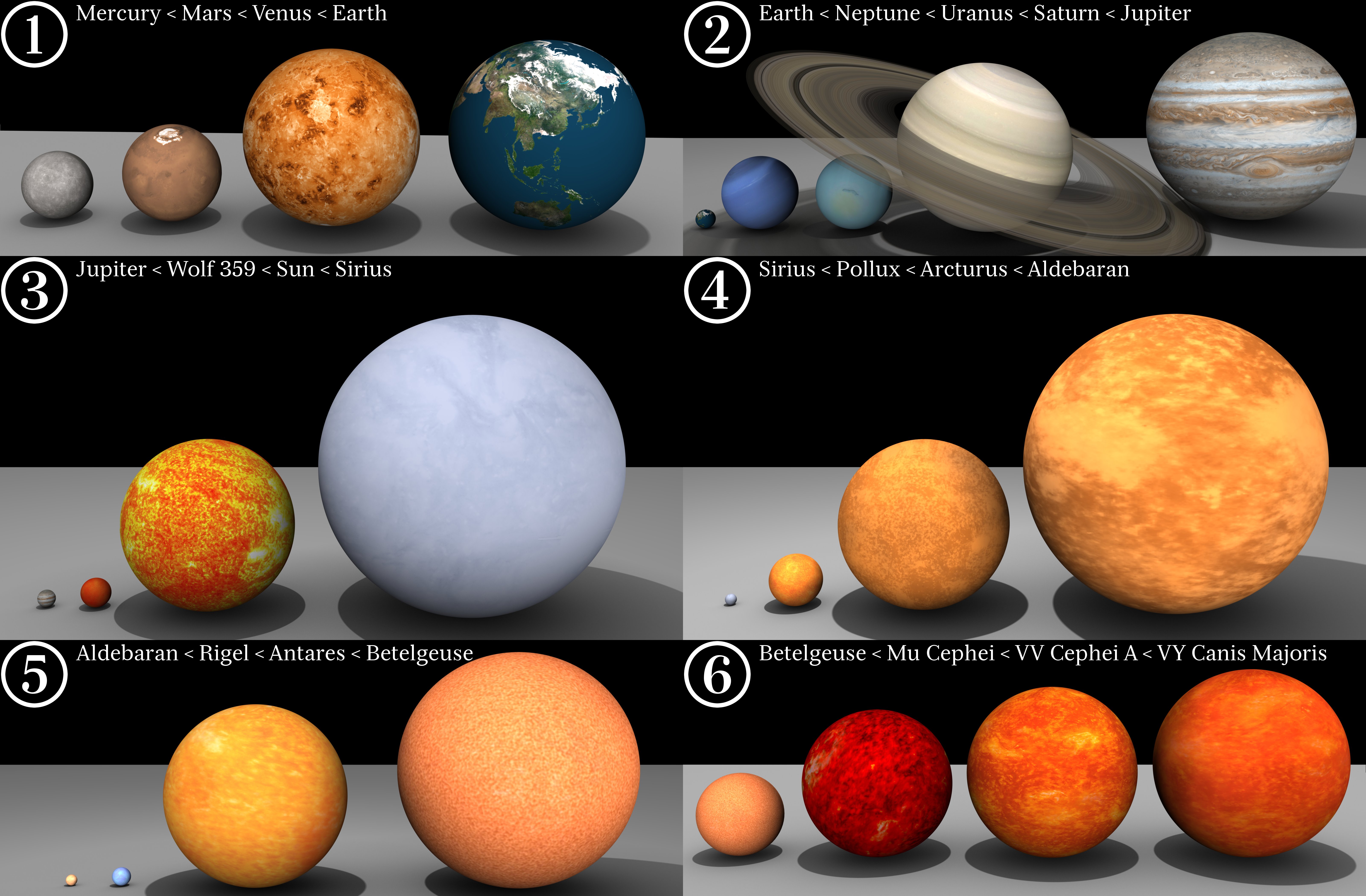
Relative Planet/Star Sizes
Wow! Look at this, and note how stunningly small our sun is compared to the biggest stars!
lyrics: We are all made of stars, by Moby. Naturally...
pax hominibus,
agape to all,
joel
Labels: astrophysics, personal bookmarks, sacred texts, sustenance, theological sources
Sunday, June 7, 2009
The Latest on Nuclear Fusion
While I still remain skeptical about the actual likelihood of success for this iteration of the process of creating contained nuclear fusion at Lawrence Livermore's National Ignition Facility (NIF), I am also hopeful that this will help guide our research.
Lasers, lasers, and more lasers. And amazing amounts of instantaneous energy. Wow. Maybe a little scary too.
I'm just thinking of all the good we could do with all the energy nuclear fusion could provide us. We wouldn't have to bat an eye about the high energy costs of desalinization. We could power an energy grid that could mean we have clean trains running from every city on each continent, and we could even power boats and individual transit eventually once we get the battery technology up and running. Of course, sadly, there's probably also a lot of bad we could do with that energy, and I'm not going to devote my own energy toward considering it. But what awesome/awful wars we could have with that much energy! But all sardonic attitude aside, with all that energy, we'd have a surplus of it, and energy wouldn't be a scarce resource. Without scarce resources, the reasons for going to war are greatly diminished.
chant/prayer/mantra: Let there be light.
pax hominibus,
agape to all,
joel
Labels: astrophysics, desalinization, pax hominibus/bright shiny future, renewable energy, technology
Saturday, April 4, 2009
From Recent News
I really do think it won't be too long before we have battery technology that is clean to make and clean to use, and requires no disposal. Two decades, though we've got to keep the R & D coming. Plenty of jobs to invest there -- get the kids in higher education for free, and make sure we've got housing, food and clothes for everybody.
Offshore wind farms which more than meet US energy needs:
While I think its high time we turn to renewable resources for energy production, I wonder why the big push for putting wind farms offshore? It seems they'd be a lot of work to set up, and then get the energy back to the mainland, even if only in relatively shallow water. Looking at this wind map (the multi-colored one on the left) and this one of South Dakota (with a legend explaining the colors), it appears there's a LOT of wind energy to be had in the middle of the country, though from the first map, it really does look like there's even more just offshore. All I know is that if there's wind there and we know it, it's a lot better than drilling for oil and not knowing how much is going to be there.
And astrophysics geeks talking about the science behind FTL warp drives:
The comment by Geckipede is a helpful explanation of what I was talking about in an earlier post.
"The problem is that in order to have a region of spacetime moving in relation to the outside universe, space has to expand behind it and contract in front, which demands negative and positive gravity in those regions. You need a large negative mass held in place in front of you, and a large positive mass behind." [Joel adds: All you have to do is carry around your own quasar and black hole, and you're set. But put the black hole at the front, and try and scale it back a bit so it doesn't actually tear a hole.]
lyrics: "Space, I believe in space... Jefrey, with one f, Jefrey."
From Space (I Believe in), by Pixies.
pax hominibus,
agape to all,
joel
Labels: astrophysics, education, renewable energy, slashdot, technology, USA
Friday, March 20, 2009
School for Champions
Last night, I was thinking about gravity-powered spaceship design*, and realized I need to brush up on my physics.
While doing a search for gravity, force, and energy, I came across this great site, called School-for-Champions, which seems to have lots of great info for first time learners, and long-rusty reviewers.
lyrics: "Build me a mountain, lord. High enough to climb to the top, so I can reach for you."
From Psyche-Out, by Meat Beat Manifesto
*The basics of the design are a massive (10 km long, 2 km wide) toroidal hull that operates like a jet engine, with gravity as its force The front side of the toroid is pulling,
 and there's a gravity gradient within the hole of the toroid that leads to the rear side of the toroid which is anti-gravity. The good thing about this design is that people will live inside the torus, along the spindle (toward the higher gravity end), so not only does the gravity propel the ship, it also provides a way for people and plants to know which end is "up." Once we figure out how gravity and electromagnetism are related, and put more research into magnetic levitation trains (and their offshoots), and learn more about how the Earth's sweep around the Sun is a form of gravitational curvature, we'll be well on our way toward this technology. Eventually, these drives will approach warp one, if not exceed it somehow. The other things we'll need to figure out are how to successfully design a closed biosystem, so that we take into account all of the matter and energy within the ship.
In the meantime, Earth is our ship, in this elliptical path, and we need to understand and appreciate this closed biosystem, so we can better maintain it.
pax hominibus,
agape to all,
joel
Labels: astrophysics, education, personal bookmarks, theological sources
Thursday, March 5, 2009
Encouraging Stories: Gravitational Waves, Net Neutrality, and Flashlights
lyrics: "Oh this burning beard, I have come undone."
colors: red, white, and blue
mood: ready for bed.
chant/prayer/mantra: what holds us separate? what keeps us separated? as we walk the streets, what still connects us? (faithful fools mantra)
pax hominibus,
agape to all,
joel
Labels: astrophysics, personal bookmarks, politics, renewable energy, technology